
The new structure means that ESNL will now work with working groups organized according to market. The organization aims to deepen the substantive discussion for each area of application and increase relevance for members. The working groups will have the following focus:
-
Large-scale – focused on energy storage facilities with their own metering equipment that are directly connected to the electricity grid, both standalone and in combination with generation. The guideline is a capacity above 20 MW. This group will mainly focus on topics related to large-scale electricity storage and the role of molecular storage.
-
Industry and businesses – for storage that shares a grid connection with large business consumers, as well as heat networks and smaller co-locations (< 20 MW) with wind and solar parks. Discussions are expected to arise here, particularly regarding medium-sized electricity storage, heat storage, and molecule storage, both stationary and mobile.
-
Built environment – focused on storage for households and small business consumers behind the meter, as well as neighborhood storage and mobile solutions. This working group emphasizes residential electricity storage and heat storage.
Policy priorities in each working group
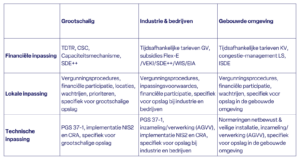
All three working groups address the same policy priorities: financial, local, and technical integration. These themes form the starting point for the discussions. Illustrative topics are included in the appendix. During the first meeting, the participants jointly determine which priorities are most urgent. These are then laid down in an annual plan for each working group.
Each working group meets four times a year in 2.5-hour meetings, alternating between physical and digital meetings.
Register to participate
ESNL is now asking members to indicate which working group(s) they would like to actively participate in, and which groups they would like to stay informed about as so-called agenda members. Agenda members receive information and invitations to online sessions; active members also participate in the physical meetings.
Members can submit their preferences via a shared link. Active participants are asked to briefly state which objective they would like to focus on within the working group.
Follow-up process
Members are requested to submit their applications by December 8 respond. They will then receive an invitation to the working groups for which they have registered. ESNL is looking forward to the start of this new phase and invites members to contact us if they have any questions.