

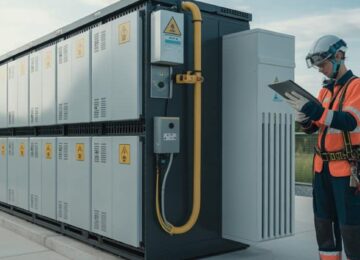
Batteries as congestion softeners
To understand what a congestion easement is, it helps to look back at the development of the electricity system. In the late 18th century, municipalities established their own power companies to provide residents with gas and electricity. Because this required large investments, production and distribution were seen as public tasks. During the 20th century, local companies merged into regional parties.
In the 1980s and 1990s, national energy companies were created. To create a free European market, the unbundling law was introduced: grid management became a public task, production a market activity. Reliability of the grid is crucial because major power failures cause enormous social damage. At the same time, competition in production had to ensure efficiency.
Grid friendly
Today the European market is working well, but the energy transition is creating new bottlenecks. The biggest problem is grid congestion, which costs the Netherlands many billions annually. Building new infrastructure takes
often 10 years or longer, while electrification and renewable generation grow exponentially. Network operators are focused on reliability, while regulator ACM monitors efficiency. As a result, for a long time tariffs were only increased in
concrete applications, not anticipating future growth - an approach that is now deficient. Moreover, innovations arise primarily from market participants, leaving grid operators with little direct control. This makes the discussion of batteries as congestion relievers complex. Energy storage is relatively new to the system and until a few years ago there were no regulations for it. Also, the term ‘congestion reliever’ does not appear in European or national codes. In other countries it is often referred to as ‘grid friendly.
Perspective of grid operators
For grid operators, reliability is paramount. Ideally, they would have full control over batteries, but ownership is prohibited in European regulations, as grid operators are not allowed to influence the market. Only fully integrated grid batteries (‘grid boosters’) are allowed, but then again they may not be used for congestion management, since congestion services can be provided by market parties.
An alternative is for market participants to own batteries while grid operators are given limited control through contracts or alternative transmission rights. Consider agreements that require a battery not to charge or discharge about 15 percent of the time, or capacity constraint (cbc) and capacity control (csc) contracts. The more hours a grid operator can control, the more security this provides. From this perspective, a battery is only a congestion reliever if the grid operator has sufficient confidence.
Perspective of market participants
Market participants almost always view batteries as congestion relievers because they charge at low prices (surplus) and discharge at high prices (shortage). Studies from the United Kingdom show that batteries account for 97 to 98 percent of
time relieve the grid. The remaining 2 to 3 percent they cause congestion by providing system services to the national grid operator. Market participants believe that grid operators should set their own priorities: if congestion is more important than system services, congestion areas should be designated first.
Towards a common definition
Although perspectives differ, there is mutual understanding. Network operators recognize that market participants need investment security, while market participants understand that network operators want control for reliability. A workable definition of ‘congestion easing’ should serve both interests. The unbundling law brought an efficient market, but good consultation between public and private parties remains essential for a reliable, affordable and sustainable energy system!
Koen Broess
Member of the Board of Directors of Energy Storage NL.
This column was published in Solar & Storage Magazine March 2026
Latest News
 News
News
Internet consultation: Amendment decree on energy storage systems for electrical energy and storage of energy carriers
March 27, 2026 News
News
Retrospective Energy Storage Conference
March 25, 2026 News
News