

GES and TenneT conclude first Capacity Control Contract with congestion reliever for Sequoia battery project at Oosterhout municipality
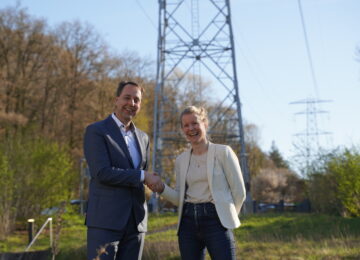
Green Energy Storage (GES) and TenneT are taking an important step in relieving grid congestion in the Netherlands. For the Sequoia battery project in the municipality of Oosterhout, GES enters into a Capacity Control Contract (CSC) with TenneT as congestion reliever, in combination with a time-delayed transmission right (TDTR).
In doing so, GES acts as the first congestion mitigator to enter into a CSC with TenneT, in conjunction with a TDTR contract. With this cooperation, both parties demonstrate how flexibility can concretely contribute to better utilization of the existing power grid.
Sequoia as concrete solution to grid congestion
The Sequoia project involves a large-scale battery energy storage system of approximately
200 MW / 800 MWh.
For the project, the environmental permits for both the energy storage system (EOS) and the route are irrevocable. At the same time, the connection to the high-voltage grid is currently under construction by TenneT.
The battery is used flexibly to support the power grid by:
- make assets available at times of scarcity
- reduce peak load on the grid
- utilize transportation capacity more efficiently
In doing so, Sequoia makes a direct contribution to creating space on an overloaded power grid.
From system challenge to concrete application
The Netherlands faces a major challenge: the rapid growth of renewable energy is putting pressure on the electricity grid in many places. While grid expansion remains necessary, additional solutions are essential to free up capacity in the short term.
The CSC contract defines how flexibility from large-scale battery storage is actively used to reduce congestion. Sequoia is thus a concrete example of how market parties and grid operators are jointly developing new solutions within the existing infrastructure.
Ad Verbaas, COO at Green Energy Storage (GES):
“This first capacity control contract with a congestion mitigator marks an important step in the development of a flexible energy system. With Sequoia, we are demonstrating how large-scale battery storage can already concretely contribute to relieving grid congestion today.”
Maarten Abbenhuis, COO at TenneT:
“Large-scale batteries are becoming increasingly important in the energy system. They make it possible to better integrate renewable energy and keep the power grid stable. By using them flexibly, as now agreed with GES, we use the grid more efficiently and can connect more customers.”
Step toward a more flexible energy system
The Sequoia project and the CSC contract underscore that solving grid congestion requires a combination of grid expansion and smart deployment of flexibility.
Through this collaboration, GES and TenneT are taking the next step toward an energy system in which energy storage plays a structural role in balancing supply and demand.
Latest News
 Member News
GES and TenneT conclude first Capacity Control Contract with congestion reliever for Sequoia battery project at Oosterhout municipality
April 8, 2026 Member News
Nij Smellinghe pioneers: completely off gas by 2027 with revolutionary heat battery
April 7, 2026 News
News