
Funding Secured for Watergeuzen Battery: 10 MW Battery Next to Wind Farm
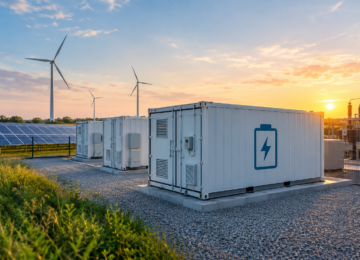
A new step in the energy transition along the A4 near Zoeterwoude! Financing for the Watergeuzen Battery has been finalized, which means this 10 MW, 20 MWh facility will actually be built. The facility will begin operations in the spring of 2027, adjacent to the ‘De Watergeuzen’ wind farm operated by Rijnland Energie Coöperatie.
The battery will store locally generated wind energy, balance the power grid, and help reduce grid congestion at the Liander substation. Renewable generation and smart storage on a single shared connection—an approach that can pave the way for growth and greater sustainability in more locations across the Netherlands.
How the Watergeuzen Battery Ensures a Flexible Energy System
The Watergeuzen Battery makes it possible to manage the times when wind turbines generate energy more flexibly. Wind energy can be stored and fed back into the grid later, depending on grid demand. This creates greater flexibility for integrating variable renewable generation and makes better use of the grid.
Rijnland Energie Coöperatie has long wanted to make further use of the site along the A4. The grid connection still has spare capacity, which can be put to good use with the Watergeuzen battery. With a capacity of 20 MWh, the battery can store more than three hours’ worth of full wind power generation from the two turbines (totaling 6 MW).
“For an existing setup with wind turbines connected to a large grid connection, it makes a lot of sense to incorporate flexibility through a battery. That way, you can make much better use of the connection.”
Joerie Kluijtmans, Emmett Green

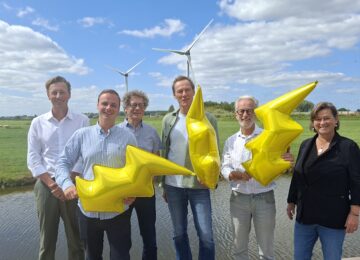
Noah Gooijer (left) and Joerie Kluijtmans (right) were involved as project leaders in the development of the Watergeuzen Battery.
In addition, the Watergeuzenbatterij will help reduce grid congestion. Joerie: “Through two separate Capacity Limiting Contracts (CBC) with grid operator Liander, agreements have been made regarding the use of the grid connection. These are alternative transmission rights. If local grid congestion threatens, Liander can temporarily limit the use of the connection. The battery adjusts its charging or discharging accordingly.” An additional benefit is that Liander can actually allocate extra capacity in the nearby industrial park to a number of companies that are currently affected by the congestion.
A partnership between local ownership and technical expertise
Emmett Green is acting as a partner in this project, providing technical expertise, and has supported the planning process by developing the data-driven business case based on simulations. In addition, the project management, permitting process, financing process, and the selection and contracting of suppliers were organized, and agreements were reached with Liander regarding congestion management. At Emmett Green, we refer to this as a ‘delegated developer.’.
“A project like this has many moving parts: permits, financing, supplier selection, and agreements with the grid operator. Our role was to bring it all together.”
Joerie Kluijtmans, Emmett Green
Emmett Green has been a co-owner from the start, along with local residents through the Rijnland Energie Coöperatie and the Meewind investment fund. Noah: “We were able to secure a loan from StartGreen Capital to cover the remaining investment costs.”.
The Emmett Green's Energy Management System (EMS) optimizes the use of battery capacity and manages the Watergeuzen battery from the moment it is put into service.
The system takes into account market prices, energy forecasts, the status of the assets, and agreements with the grid operator. The EMS also takes into account the output of the wind turbines. Based on this, it directs the battery toward the application that yields the most value at that moment, within the contractual limits. This could be on the intraday and imbalance markets, but also via aFRR or redispatch through GOPACS.
“An EMS is a key component for ensuring compliance with agreements with the grid operator and for using the battery intelligently in the market.”
Noah Gooijer, Emmett Green
Construction and Completion of the Watergeuzen Battery
Construction of the foundation will begin this fall. In the months that follow, the cabling and connection of the battery containers, inverters, and transformer will take place, followed by testing and calibration of the control system. A living hedge will be planted around the installation to help the system blend into the landscape.
In the spring of 2027, the Watergeuzen Battery will be operating at full capacity and will contribute to a more flexible energy system in the region. Local residents will share in the revenue generated by both the wind turbines and the battery.
Opportunities for Battery Systems in Existing Grid Connections
Entities with existing renewable energy generation and assets can strengthen their business case by installing a battery on the same grid connection. Large-scale battery storage next to a wind farm or solar farm is gaining ground in the Netherlands. Energy cooperatives are already demonstrating this, such as with the AmstelbatterEi from De Windvogel near Ouderkerk a/d Amstel.
“Especially with variable renewable energy generation, it’s very useful to add flexibility at the front end of the chain. That way, less additional infrastructure needs to be built further down the line.”
Similar opportunities exist at solar farms that are reaching the limits of their grid connections, as well as at industrial sites where multiple parties share a single connection. A battery storage system with smart controls extracts additional value from existing assets and helps integrate renewable energy more effectively into the grid.
Image: Emmet Green