

DNE and IEA: Battery Storage Is Growing Rapidly; Smart Integration Will Be Crucial
The Dutch battery market continues to grow steadily, and globally, energy storage is also playing an increasingly important role in the electricity system. This picture emerges from the National Storage & Solar Trend Report 2026 from Dutch New Energy Research (DNE) and the World Energy Outlook 2026 from the International Energy Agency (IEA). The overarching message: more storage is needed, but the greatest value is created when storage, generation, consumption, and the power grid are well coordinated.
The reports examine this development from various perspectives. DNE maps out the Dutch market and projections through 2028; the IEA examines how the global energy system will evolve under various policy choices. Together, they demonstrate that battery storage is increasingly less of a standalone addition to renewable generation and is becoming an integral part of the energy supply.
Netherlands: 4.5 GWh of new battery capacity expected in 2026
DNE expects the Netherlands to add approximately 4.5 gigawatt-hours (GWh) of new battery storage capacity in 2026: 64 percent more than in 2025. The projected increase consists of 2 GWh from households, 1 GWh from commercial and industrial applications, and 1.5 GWh from large-scale projects. According to the market forecast, this will bring the total Dutch battery capacity to nearly 8.9 GWh by the end of 2026.
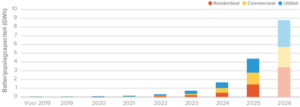
Figure 1 “Total Installed Capacity of Battery Storage Systems in the Netherlands”
Residential batteries are a key driver this year. DNE forecasts approximately 225,000 new systems in households and attributes this growth, in part, to the end of the net metering program as of January 1, 2027. For businesses, the value also lies in making better use of a limited grid connection: storage, combined with local generation and energy management, can provide opportunities for electric vehicle charging, sustainability, and expansion.
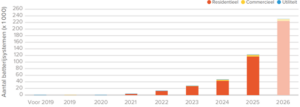
Figure 2: “Number of newly installed battery storage systems in the Netherlands”
For 2028, DNE forecasts further growth in all three scenarios, reaching a total battery capacity of 32.5 GWh in the low scenario, 38.0 GWh in the base scenario, and 46.9 GWh in the high scenario. In the base scenario, the expected completion of large-scale projects in particular is driving a sharp acceleration. These are scenario outcomes, not capacity that has already been realized: the estimates are based, among other things, on assumptions regarding solar panel storage and the development of large-scale projects.
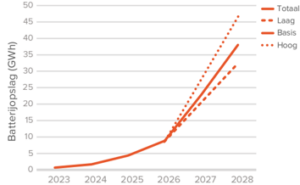
Figure 3: “Forecast of total installed battery storage capacity by scenario”
According to DNE, the impact of battery storage is already visible in the Dutch electricity market. The chart showing average day-ahead prices indicates that the afternoon dip in 2025 will be less pronounced than in 2024. DNE also observes that evening prices are lower than would be expected based on the general price level. The report interprets this as a flattening of the daily price profile, also known as the duck curve As mentioned: batteries store electricity during off-peak hours and release it during more expensive evening hours. This allows them to smooth out price fluctuations throughout the day.
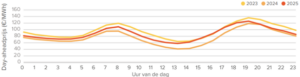
Figure 4: “Average day-ahead price by hour of the day”
IEA: Storage Is Growing in All Future Scenarios
The IEA places the Dutch development within a broader trend. Globally, approximately 115 gigawatts (GW) of new battery storage capacity was installed in 2025. In the Current Policies Scenario (CPS), which is based on established policies, total installed capacity will grow from nearly 300 GW in 2025 to nearly 1,800 GW in 2035. In the Stated Policies Scenario (STEPS), which also includes formally proposed policy measures, that capacity exceeds 2,100 GW. The climate-focused Net Zero Emissions by 2050 (NZE) scenario projects more than 3,300 GW by 2035.
At the same time, the need for flexibility is increasing. The IEA expects that the short-term need for flexibility will more than double by 2035 in both CPS and STEPS; in the NZE scenario, it will increase by a factor of 3.5. In STEPS, batteries are projected to grow globally to account for approximately 40 percent of short-term flexibility by 2035. They shift electricity within the day, working in conjunction with demand response, hydropower, and adjustable generation, among other sources.
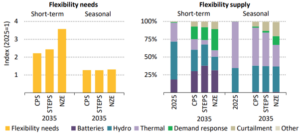
Figure 5: “Global Short-Term and Seasonal Flexibility Needs and Supply in the CPS, STEPS, and NZE Scenarios, 2025 and 2035”
From Rapid Growth to a Sustainable Business Case
Falling prices are driving the development of energy storage. According to the IEA, prices for large-scale battery storage fell by nearly 40 percent in 2025. Storage is also increasingly being combined with solar and wind farms to make better use of existing grid connections and make electricity available at times when it is more valuable. In STEPS, the IEA expects that, by 2035, solar plus storage will be more competitive than solar without storage in key markets when the value to the electricity system is also taken into account.
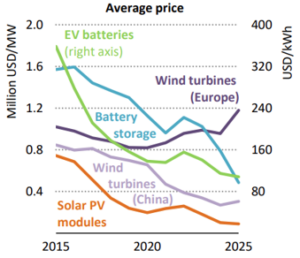
Figure 6: “Global Average Price of Selected Energy Technologies, 2015–2025”
This trend does not mean that every battery is automatically profitable. Both reports describe how increasing competition can put pressure on revenue from flexibility markets and make it more important to combine revenue streams. In addition, both reports note a shift from short-duration systems to batteries capable of providing power for four hours or longer. As a result, when making investment decisions, factors such as storage duration, financing, control systems, and access to various markets—not just the purchase price—become decisive.
Increased storage also requires the right conditions
For the Netherlands, the link between national electricity markets and local grid capacity is particularly important. Storage does not automatically help the grid: location, transmission arrangements, and control mechanisms determine the contribution a battery can make. The IEA also emphasizes that storage in conjunction with renewable generation does not eliminate the need for broader grid reinforcement.
Security and digital resilience also deserve attention. DNE highlights the risks of centrally controlled battery systems; the IEA warns that digitalization and dependence on concentrated supply chains can create new vulnerabilities. Furthermore, while battery storage provides intraday flexibility, it is not a complete solution for extended periods with little sun or wind; for such situations, the IEA outlines a broader range of flexibility sources.
For Energy Storage NL (ESNL), the challenge is clear: link the growth of storage to tangible value for the energy system. This can only be achieved if the right framework conditions and location-specific incentives are created, so that market players can develop profitable projects precisely where storage is needed. ESNL therefore calls on the national government and local authorities to take the lead in spatial planning and to expedite the permitting process. Grid operators must clearly indicate where and when storage can support the grid and offer workable transmission contracts and appropriate availability fees for this purpose. In addition, ESNL is asking the ACM to establish grid tariffs that do justice to the system function of storage, and the national government to provide financial instruments that recognize the societal value of storage. Simply designating a suitable location is not enough: the conditions must also enable development and operation at that site.
With the Energy Storage Policy Agenda ESNL, the government, and network operators, in collaboration with local authorities and the ACM, have taken an important first step toward this goal. The agenda includes action items related to, among other things, site selection, permitting, contract terms and fees, and improving the business case. ESNL calls on these parties to now vigorously translate the agreements into a workable approach, with a clear point of responsibility, a timeline, and a targeted outcome for each action. Systematically involve market participants in the implementation process so that the measures align with practical realities and actually lead to investments. This will facilitate the transition from rapid market growth to grid-conscious and financially sustainable storage projects. See also the ESNL's response to the Energy Storage Policy Agenda.
Latest News
 News
DNE and IEA: Battery Storage Is Growing Rapidly; Smart Integration Will Be Crucial
November 26, 2026 News
EU Reaches Agreement on Faster Permitting for Energy Storage and Energy Infrastructure
November 24, 2026 News