
Master Class Recap: From Safety Guidelines to a Battery Project
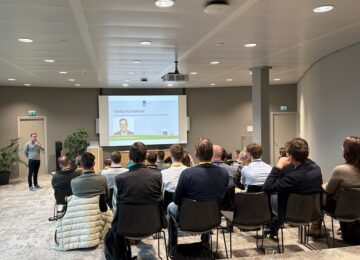
On November 3, Energy Storage NL (ESNL) and New Energy Business School (NEBS) organized an event at Hager a master class in Den Bosch on PGS 37 and battery storage. The key message for the energy storage sector: a responsible battery project requires a balance between safety, economic feasibility, and technical implementation. Through presentations and a tour of Hager’s energy storage facility, ESNL and NEBS linked knowledge about guidelines and business cases to real-world practice. Participants received practical guidance on how to safely integrate a system and align it with energy needs.
Safety Takes Shape in the Design
Corné Groen of TAUW discussed the practical application of PGS 37-1 and the Amendment Decree on Energy Storage Systems. He distinguished between the current legal situation and the proposed regulations and addressed the implications for permitting, oversight, and responsibilities. For a battery project, this means making concrete decisions: where can the facility be located, what safety distances are required, and how do you demonstrate that risks are being managed? Site selection, detection, accessibility, and documentation are therefore integral to both the design and the justification of the project.
To translate these safety decisions into a well-founded report or permit application, the Guide to Energy Storage Systems, which TAUW published on behalf of the Ministry of Infrastructure and Water Management, provides practical guidance for project initiators, municipalities, environmental agencies, and safety regions.
The business case starts with the application
ESNL board member Robert Kleiburg demonstrated that the starting point for a business case is not the battery itself, but the need for flexibility. The growth of solar and wind power, electrification, and grid congestion are increasing the need for flexibility. However, the role a battery can play varies by location. Based on the energy profile, Kleiburg demonstrated how to determine the appropriate power, capacity, and storage duration. In addition to energy trading, limiting consumption peaks and increasing self-consumption of solar power can also generate value. Combining these applications requires clear priorities and smart management within the limits of the grid connection. Using a practical simulation, he demonstrated why gross revenues are not sufficient to assess feasibility: grid tariffs, payments to market participants, and battery degradation also factor in. An exceptional trading year therefore does not provide a basis for fifteen years of revenue projections.
From Presentation to Practice
During the tour of Hager’s energy storage container, participants saw how the principles of PGS 37-1 are incorporated into an installation. Camiell Pauw explained that a storage system involves more than just batteries: the electrical distribution system, control systems, ventilation, and sensors are all part of the whole. Hager also shared lessons learned from the development process. The design requires more time and money than initially budgeted, and effective coordination between components and stakeholders is crucial. The practical setup thus demonstrated how safety measures and technical choices come together in a battery project.
Through this masterclass, ESNL and NEBS brought together expertise on safety, economic feasibility, and technical implementation. The practical next step for participants is to assess these elements holistically from the outset: substantiate the application and business case, explicitly define safety choices, and coordinate the technical implementation with suppliers and consultants. In doing so, discuss the responsibilities and required documentation with the competent authority. In this way, knowledge sharing within the energy storage sector helps ensure that battery projects are implemented safely and responsibly.