
How is Flevoland breaking new ground in energy storage?
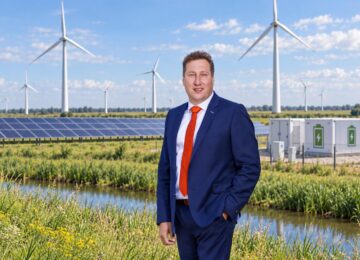
How do you utilize generated wind and solar energy when the power grid is at capacity? Flevoland is seeking the answer in energy storage, flexible consumption, and local collaboration. According to Harold Hofstra, Deputy for Energy for the province of Flevoland, this requires looking ahead and daring to pioneer. On behalf of the provinces, he also serves as the national coordinator for grid congestion and hydrogen. What solutions are emerging in the polder, and what can other regions learn from them?
From Generating More to Making Better Use of It
According to Hofstra, Flevoland has a strong starting position as a producer of renewable energy. He cites approximately 6.3 terawatt-hours from solar and wind and nearly 7.3 terawatt-hours in total renewable generation. According to him, this means the province accounts for 20 to 25 percent of the Netherlands“ renewable generation. Hofstra also notes that Flevoland has more than met the targets set out in the Regional Energy Strategy. It is precisely this high level of production that makes it necessary to look beyond generation alone. “If we generate that much renewable energy, what are we going to do with it?"
According to Hofstra, Flevoland’s lead is not solely due to the fact that the province has space for energy projects. For more than two years, the province has been focusing on flexibility and developing policies to that end. In doing so, Flevoland is anticipating bottlenecks that will arise when large quantities of renewable electricity become available. “That's what Flevoland is all about: pioneering and doing things that haven't been done before."
Grid congestion affects more than just the power grid
"We’re definitely still experiencing problems. The impact of grid congestion is significant here as well”, Hofstra emphasizes. New connections are taking a long time to materialize, and sustainability efforts are stalling because the power grid is at capacity. For him, grid congestion is therefore not just a technical problem, but also a spatial and economic challenge. It affects the ability to advance business, housing, and other developments.
The Flevopolder is electrically connected to Gelderland and Utrecht; the Noordoostpolder and Urk belong to a different grid area. According to Hofstra, the joint FGU area has now been subdivided into five smaller congestion areas, while the areas remain connected. He sees major bottlenecks primarily in Utrecht, while elsewhere there are more opportunities to organize flexible capacity. The ACM agrees that smaller congestion areas provide better insight into where flexibility is needed and how much grid capacity that can yield.
A Dedicated Framework for Energy Storage
Flevoland is the first province to adopt a comprehensive policy framework for large-scale energy storage using batteries. The policy, adopted in April 2026, builds on a pilot framework from 2023. It clarifies where batteries can be installed and how they should fit into the landscape and the energy system. The formal framework stipulates that batteries must not increase grid congestion and includes additional conditions for each specific application.
Hofstra emphasizes that batteries must actually contribute to the solution. “A battery should help alleviate traffic congestion.”For him, storage is not an end in itself, but must support the energy system. He sees large-scale battery systems at high-voltage substations, solar farms, and wind farms as one of the greatest opportunities at the moment. In addition, he expects hydrogen, thermal storage, and other forms of long-term storage to play an increasingly important role.”.
Organizing Supply, Demand, and Storage Locally
"I really see it as a building block of the future energy system”, says Hofstra about battery storage. “Storage allows us to temporarily store excess energy and use it when demand is higher.” According to him, energy storage can thus help prevent wind turbines from having to be shut down due to grid congestion. The electricity generated then remains available for later use, at which point the battery can support the grid.
Hofstra also sees opportunities in energy hubs, where companies jointly organize their energy supply. Businesses share a connection, make joint agreements, and coordinate their business processes. This involves not only shifting consumption but also using less energy. A battery can store solar power generated on company rooftops to charge trucks at a later time. This way, generation, consumption, and energy storage come together, rather than companies addressing these issues separately.
Charging Electric Buses with Local Wind Energy
A concrete example is the transition to sustainable bus transportation in Almere. New electric buses require charging capacity, while the regular power grid offers limited capacity. Energiehub Zeewolde and Keolis have therefore entered into an agreement for a charging and parking facility near the A6. Starting in 2028, approximately eighty electric buses will be supplied with locally generated green electricity via the energy hub’s own power grid.
Hofstra describes how a closed power grid gives the buses direct access to energy from the wind farm. According to him, part of the energy will also be used to build a hydrogen refueling station along the A6. In doing so, he also aims to fill a gap in the refueling infrastructure. In this way, the combination of local energy production and mobility makes a sustainable bus concession possible, despite the limitations of the public grid.
Hydrogen requires a connection to the rest of the Netherlands
In addition to batteries, Hofstra sees an important role for hydrogen. He mentions an approved initiative for a hydrogen plant with a target capacity of more than 100 megawatts. The project information on HyDeer in Lelystad specifies an initial phase of 20 megawatts and a potential expansion to 105 megawatts. According to the consulting firm involved, the necessary permits have been obtained.
The Maxima power plant also plays an important role in Hofstra’s plans. He points out the possibility of co-firing up to 50 percent hydrogen and emphasizes that this requires infrastructure. According to Hofstra, the lack of a connection to the national hydrogen network is a major obstacle.
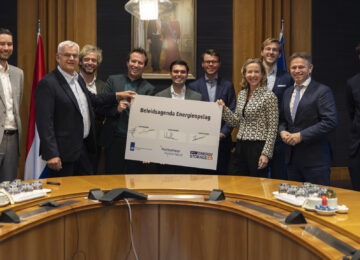
Administrative steps have now been taken toward a regional connection. Hofstra mentions an agreement that has been concluded with, among others, the province of Overijssel. In June 2026, government agencies and businesses from Flevoland and Northwest Overijssel signed a cooperation agreement and requested a feasibility study for a connection. Hofstra advocates for a connection via Zwolle and Lelystad to the Maxima power plant, which would then connect to the main grid in the direction of Diemen. “Actually, we want to turn that loop into a figure-eight.”According to him, that additional connection makes the national network more robust, because it ensures that an alternative route remains available in the event of an outage.".
An energy mix that enables sustainability
According to Hofstra, the energy system of the future requires more than just solar and wind power. He envisions a combination of batteries, hydrogen, thermal storage, flexible consumption, and on-demand energy production. Fossil fuels must be phased out as much as possible, but he does not rule out a limited role for natural gas. He points to the project with Vattenfall in Almere, for which, according to him, a contract has now been signed. There, a gas-fired power plant is being combined with a large battery to provide additional flexible capacity. “With just a small amount of gray, you can give a boost to further sustainability efforts."
According to Hofstra, farmers are also working on new combinations. With solar panels on barn roofs and, in some cases, their own wind turbines, they are getting started with hydrogen production. The goal is to have tractors and heavy equipment run on hydrogen in the future. In addition, Hofstra cites research that, in his view, demonstrates significant potential for green gas derived from waste streams. He also sees opportunities to use existing gas infrastructure for hydrogen. In this way, energy sources should complement one another and further reduce the use of fossil fuels.
Building Tomorrow's Energy System
Hofstra emphasizes that expanding the power grid remains essential. At the same time, regions must not only solve today’s problems but also build the energy system of tomorrow. According to him, this requires clear, stable regulations, workable permitting procedures, and investments in infrastructure. For the major housing construction projects in Almere and Lelystad, he wants to adopt “grid-conscious construction” as a guiding principle: taking the load on the grid into account from the design stage onward. He sees energy-neutral and, ultimately, energy-producing buildings as the next steps.
According to Hofstra, households, businesses, and electric vehicles must become part of a smarter, more flexible, and more decentralized energy system. Energy storage serves as a buffer in this system, allowing more locally generated energy to be used locally. This should contribute to a reliable and affordable energy supply. However, available space is not unlimited. Hofstra points to new high-voltage infrastructure, the planned barracks in Zeewolde, and the military’s shared use of Lelystad Airport. These developments also require space and raise new energy challenges.
Pioneering requires experience and collaboration
Flevoland has long had experience integrating energy projects. Hofstra explains that wind turbines have been part of the province since the 1980s. Through upscaling and restructuring, Flevoland is opting for fewer, more powerful turbines arranged in coherent rows. He describes the shift from nearly 800 to 400 to 500 turbines, which he says will double capacity. This should increase energy production while also improving the projects’ integration into the landscape.
According to Hofstra, the province is taking on the role of area coordinator: bringing stakeholders together and facilitating coordinated development. This requires the involvement of municipalities, the national government, utility network operators, and the Netherlands Authority for Consumers and Markets. Together, they must identify where existing regulations are creating obstacles and how to create room for new solutions. “As a province, we would like to take a leading role, but we cannot do it alone.”For him, therefore, pioneering also means making arrangements that turn a promising idea into something that can actually be implemented.".
Learn from practical experiences with energy storage
According to Hofstra, solutions implemented in Flevoland, Gelderland, and Utrecht have already yielded results and created additional capacity on the grid. These experiences are also relevant for provinces such as North Brabant and North Holland, where he sees similar problems emerging. “You don't have to figure it out on your own.” He calls on other regions to look into where solutions have already been implemented, tested, and proven effective. As far as he’s concerned, other provinces should also adopt Flevoland’s battery framework. In this way, knowledge sharing can help accelerate the implementation of measures to combat grid congestion.
Would you like to discover how energy storage, flexible consumption, and collaboration reinforce one another? Then come to The Energy Storage Event on December 3, 2026, where Harold Hofstra will also be speaking. You’ll meet organizations working on electricity storage, thermal storage, and molecular storage, and delve into storage locations, permits, regulations, and the business case. This way, you’ll learn from real-world experiences and explore which solutions are best suited for your region or organization. Download the brochure for an overview of the entire program.
This interview appeared in ClimateEnergy.nl