

Cabinet commits to strengthening decentralized energy systems: opportunities and concerns for energy storage
The cabinet recently published a new parliamentary letter on strengthening decentralized developments in the energy system. In this letter, the Cabinet outlines how local generation, storage and consumption of energy should be more explicitly connected in the future. According to the Cabinet, this is essential to reduce grid congestion, accelerate the energy transition and keep the energy system affordable and reliable.
The letter marks a shift to a more decentralized energy system, in which energy is organized as close to demand as possible. According to TNO, this could lead to savings of €4.5 to €24.5 billion in grid investments. At the same time, the government emphasizes that this potential will only be realized if generation, storage and consumption are better coordinated.
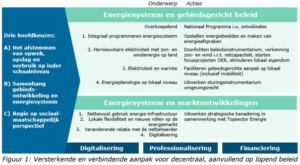
To achieve this, the government is taking a coherent approach to strengthen the preconditions for decentralized development, as shown in Figure 1. The approach focuses on the three main choices for decentralized and translates them into concrete actions in two tracks: 1) Energy system and area-based policy and 2) Energy system and market developments. Both tracks also flesh out the success factors of decentralized from the previous parliamentary letter: digitization, professionalization and financing. Both tracks address the role of energy storage. Below, ESNL explains how storage is reflected in them and provides its response.
Integral programming energy system
Within track 1, it looks at the Integral programming energy system. For energy storage, this development means that batteries and other storage technologies are becoming an increasingly explicit part of spatial and regional energy planning. Instead of separate projects, storage is being included in integrated “energy pictures” in which generation, consumption and storage are weighed up together. This offers opportunities to position storage more strategically, for example in places where the electricity grid is under pressure or where supply and demand can be better matched.
Renewable electricity with onshore solar and wind power
Furthermore, within track 1, the Renewable electricity with onshore solar and wind power. The letter confirms that onshore solar and wind energy will continue to play a major role in the energy system towards 2040. At the same time, the government recognizes that focusing only on more generation is not enough: combining generation with storage and local consumption will be crucial to keep the system functioning efficiently. Without storage, additional generation will lead more quickly to grid congestion and inefficient use of the electricity grid. The government is therefore exploring how instruments can be better aligned with this integrated approach and is committed to grid-efficient integration of solar and wind projects, including in combination with storage, for example on government land. This offers opportunities for storage, but also requires policies that explicitly focus on the combination of generation and flexibility, rather than on generation alone. ESNL calls on the government to give concrete substance to this. Adding storage within the latest round of the SDE++ would be an important step, as would explicitly including storage in the terms of the two-way contracts (CfDs) that will eventually replace the SDE++.
Energy planning at the local level
In addition, within track 1, efforts are being made to develop energy planning at the local level. The government, together with provinces, municipalities, grid managers and the Minister of VRO, is exploring how decentralized authorities can be given more opportunities to spatially manage the connection between energy and area development. Instruments such as design research and working with so-called ‘energy configurations’, in which energy building blocks (generation, transport, storage and use) are linked to spatial functions, play an important role in this. Storage thus becomes part of spatial considerations rather than an addition afterwards. This offers opportunities for strategic integration, for example at energy hubs and local energy systems. ESNL emphasizes that it is crucial that storage is included in this planning from the beginning, so that choices contribute to a flexible and future-proof energy system.
Strategic systems approach
In Track 2, the cabinet describes how a strategic systems approach is being developed, with the goal of achieving a broad-based approach to market developments within a year that removes barriers to scaling up innovative projects. Within this track, energy storage emerges as a crucial link in integral, decentralized solutions, such as in heat networks (for example, in Veenendaal), energy hubs and charging hubs for electric trucks. The letter thus recognizes that storage is an important part of smart innovations toward the future energy system. ESNL stresses that it is of great importance that in this trajectory explicit attention is paid to the obstacles around energy storage, so that these are removed in time and storage can fully fulfill its role in the energy system.
Latest News
 Member News
QurmitXL Wins Two Innovation Awards in September
October 14, 2026 News
News
ACM Introduces Time-of-Use Grid Rates: An Important Step Toward Flexibility and Energy Storage
October 12, 2026 News
News