

ESNL members work on energy storage solutions in working groups
Energy Storage NL organizes three working groups (Large Scale Storage, Industry & Business and Built Environment) on a quarterly basis to engage with the sector and governments on current bottlenecks, policy developments and solution directions in the field of energy storage and grid congestion. The working groups are an important platform for the storage sector and ESNL to exchange knowledge, connect parties and translate input into appropriate advocacy. Again May 12 and 13, three valuable working groups were on the agenda.
Large-scale Storage: shaping solution-oriented contract forms and market instruments together
The focus of the Large-Scale Storage Working Group was on testing proposals for new contract forms. For example, there was room for discussion of ESNL's proposal for a Capacity Control Contract (CSC), the grid operators‘ ’Swiss Army Knife. By offering an appropriate deployment and availability fee for batteries, this contract could strengthen investment security for battery projects and, in turn, help grid operators stabilize and lighten the grid. A variant of the VVTR contract, which ESNL is developing at TenneT's request to deploy batteries more as congestion relievers, was also discussed. Also explained was the GOPACS platform, which in consultation with the market is developing tools for a transparent and integrated Dutch electricity market. Finally, market reactions to the new PGS-37 in Bal were discussed by the Ministry of Infrastructure and Water Management and TenneT explained the new queuing methodology.
Industry & Business: bottlenecks around incentives and subsidies
The Industry & Business working group focused primarily on the preconditions for storage with industrial and commercial application. The Ministry of Economic Affairs and Climate kicked off the meeting with a presentation on the Flex-e subsidy. The subsidies are aimed at making energy consumption more flexible. In addition to an explanation of the possibilities within the Flex-e, a suitable interpretation of a possible Flex-XL variant was discussed together with the market parties present. Anne-Marie Spierings, cluster director in the Rotterdam-Moerdijk industrial cluster, then discussed the use of storage in industry and the preconditions for using flexibility more widely. Crucial here is that flexibility can guarantee the full-continuous processes of the chemical industry and meet very large power demands. In addition, an adjustment of the current grid tariff structure can provide more room and incentives for additional connection capacity in combination with storage. Furthermore, the NVDE explained the Regioteam Energietransitie, a cooperation between ESNL, NVDE, Energie-Nederland, Holland Solar and NedZero. Within this partnership, provincial and regional advocacy and lobbying activities around energy transition are jointly taken up. Finally, TenneT explained the grid forming code change proposal and there was discussion about where in the grid forming assets should ideally be placed: closer to users, closer to generation locations or just spread throughout the system.
Built Environment: system integration and local flex
In the Built Environment working group, attendees addressed standardization, energy control and local grid issues. There is a new NEN trajectory around the European directive EPBD IV that will replace the current NTA8800. This will adjust the Dutch calculation method for determining the energy performance of buildings. Important here is to give heat batteries and home batteries a proper place. Also looked at Home Energy Management Systems (HEMS), where smart connection of grid-intensive devices, such as home batteries and solar panels, can bring benefits. NL Flex addressed the potential of controllable devices as a solution to grid congestion and the potential of tenders with flexibility contracts as a long-term solution. Alliander introduced the new time-dependent net tariff for small consumers. This involves setting higher tariffs during time slots where consumption usually peaks than at times when there is a lot of sun and wind generation, for example. In this way, by changing behavior, space for 700,000 new homes should be freed up. ESNL also indicated that they are in talks with the Ministry of Economic Affairs about the recent connection freeze in Utrecht and the possible role that flexible energy assets can play in alleviating grid congestion. This is where ESNL wants to work with its members to help alleviate grid congestion.
From bottlenecks to targeted and broad-based solutions
The day was all about exploring new developments and bottlenecks, but above all in jointly finding concrete solutions within the fields of large-scale storage and flexibility in industries, companies and the built environment. ESNL looks back on a nice series of working groups with a broad network of attendees from, among others, two ministries, several grid operators, financiers and more than 50 companies.
Would you also like to join these working groups, sign up as a member now!
Latest News
 Member News
QurmitXL Wins Two Innovation Awards in September
October 14, 2026 News
News
ACM Introduces Time-of-Use Grid Rates: An Important Step Toward Flexibility and Energy Storage
October 12, 2026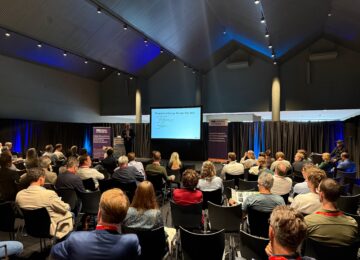 News
News