
Working Visit to the Antares Battery Project: Practice and Policy Come Together in Waddinxveen
How can we use large-scale energy storage to accelerate the energy transition in the Netherlands? That question was the focus of the working visit to the Antares battery project in Waddinxveen on July 10. Energy Storage NL organized the visit together with Return, the Ministry of Economic Affairs and Climate Policy, TenneT, Vattenfall and brought together practical experience and policy issues for other stakeholders. The visit highlighted how battery projects can contribute to a reliable, affordable, and future-proof energy system—and what conditions are needed to implement projects more quickly.
Insights into the Implementation of a Battery Project
During the afternoon, attendees gained insight into the development of Antares. Various parties demonstrated what is involved in realizing a large-scale battery project: from spatial planning, permitting, and grid connection to the business case, market development, and collaboration between the asset owner, grid operator, government, and customer.
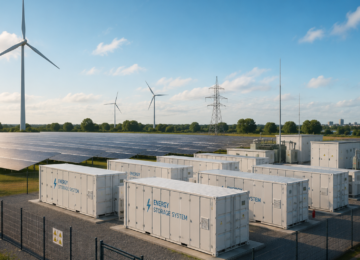
The Antares project is being developed by Return and will have a capacity of 100 MW and a storage capacity of 200 MWh. The project represents an investment of approximately €85 million and is expected to be operational by the end of 2026. Vattenfall is the “lessee” that will deploy the battery across various energy markets.
It became clear from Return’s presentations that there is much more to a battery project than just the technology. The development of Antares requires years of preparation, coordination with government agencies and grid operators, and careful navigation of the permitting process. Financing, market risks, and innovative contract models for flexible grid usage also play an important role. The collaboration with Vattenfall, the municipality, and the safety region was cited as a positive example that contributed to the project’s smooth progress.
From Theory to Practice
A key part of the afternoon was the tour of the construction site. Participants gained a concrete sense of the physical scale of the project and the practical decisions required to build a large-scale battery energy system. It was precisely this combination of policy discussion and hands-on experience that made the working visit so valuable. It demonstrated that further growth in the energy storage sector requires clear policy decisions, faster and more efficient permitting, transparent grid information, and appropriate market and grid products that reward flexibility.
Working Together on the Next Step
Projects like Antares demonstrate why energy storage is an essential building block for the energy system of the future. Batteries can help better balance supply and demand, reduce grid congestion, and make more efficient use of the power grid. In doing so, they contribute to reliable and affordable energy, provided that the conditions for implementation, market participation, and grid integration are in place.
Energy Storage NL looks back on this meeting with appreciation and thanks Return for the hospitality and openness with which the project was presented. As an industry association, ESNL continues to link practical experience from its network to policy, market development, and knowledge sharing. Only through collaboration between asset owners, grid operators, market participants, governments, and policymakers can the rollout of energy storage in the Netherlands be accelerated.