

Return and Vattenfall Sign a Multi-Year Agreement for the Sirius Battery Site and Reach Financial Close
Return and Vattenfall have entered into a long-term agreement for Sirius, a 200 MW / 800 MWh battery energy storage system (BESS) in Winschoten, Groningen. Sirius will be connected to TenneT’s substation in Meeden. Under the agreement, Vattenfall will have access to the battery’s capacity to store electricity and feed it back into the grid in exchange for a fixed fee.
Commercial operation is scheduled to begin in the fourth quarter of 2027. The project involves a total investment of approximately €180 million. This makes Sirius one of the largest battery storage facilities currently under development in the Netherlands. It is one of the largest multi-year tolling agreements with a fixed fee for battery storage in the Netherlands to date.
Long-term partnership for greater flexibility
Wind and solar power generation fluctuates, while electricity demand does not always align with it. Batteries help better match supply and demand. They store electricity when there is plenty available and release it when demand increases. Batteries can also respond quickly to changes in the power grid, thereby contributing to its stability.
Under the agreement, Vattenfall determines when Sirius is charged and discharged. This allows Vattenfall to use the battery to offset fluctuations in wind and solar energy production, better align supply and demand within its customer portfolio, and support TenneT in maintaining the balance of the power grid in real time.
The agreement builds on the existing collaboration between the two companies. In 2025, Return and Vattenfall had already signed a long-term agreement for 50 MW from Antares, Return’s 100 MW / 200 MWh battery project in Waddinxveen. With Sirius, that partnership is being significantly expanded: Vattenfall will gain access to the full capacity of a 200 MW / 800 MWh four-hour battery.
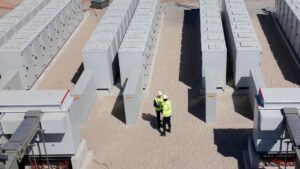
Return and Vattenfall Join Forces at the Antares Battery Facility in Waddinxveen
Funding Secured
The financing for Sirius has been finalized and is part of Return’s broader financing round for its battery portfolio, for which up to €400 million has been made available. The total investment in Sirius itself amounts to approximately €180 million. In addition to Return’s existing investors, the group of financiers includes ING, NatWest, Deutsche Bank, ABN AMRO, and Rabobank.
ING Corporate Finance acted as financial advisor to Return in the transaction. ING is also one of the lenders. Clifford Chance served as legal counsel to Return, and Dentons served as legal counsel to the lenders. Sirius is being developed in collaboration with Huawei, Hanab, and Omexom, which are responsible for the battery technology, construction, and installation.
Flexible Use of the Grid via TDTR
Sirius operates under a Time-Dependent Transmission Rights (TDTR) agreement with TenneT. This means that the battery coordinates its charging and discharging with the capacity currently available on the power grid. This allows Sirius to make optimal use of the existing grid infrastructure without further increasing the strain on the grid. At the same time, the battery helps reduce grid congestion and promotes a more efficient use of available grid capacity.
Battery Storage as Part of the Energy Infrastructure
The Dutch power grid is under increasing pressure. Renewable energy production is growing, more and more processes are being electrified, and demand for electricity is rising. As a result, available grid capacity has become one of the most significant challenges of the energy transition.
Large-scale batteries such as Sirius make the energy system more flexible. They help better align supply and demand, temporarily store surplus electricity generated from renewable sources, and support the stability and reliability of the power grid.
Multi-year agreements, such as those between Return and Vattenfall, help accelerate the development of battery storage. The revenue certainty these contracts provide makes it possible to finance and implement new large-scale storage projects. With this agreement, Vattenfall is also taking another step toward its goal of contracting at least 1.5 GW of battery capacity in the markets where it operates.
“Battery storage is rapidly becoming an essential part of the Dutch electricity system,” says Sjoerd Bazen, Managing Director of Return. “Long-term partnerships like this one make it possible to achieve the storage capacity needed to integrate more renewable energy into the system, strengthen grid reliability, and create greater flexibility. Sirius demonstrates how strong commercial collaboration can take large-scale battery storage from development to implementation, thereby making it part of the energy infrastructure of the future.”
“As wind and solar power account for an increasingly large share of our electricity supply, flexibility is becoming more and more important for a stable energy system,” says Erik Suichies, Head of Wholesale Customers at Vattenfall. “Batteries like Sirius can quickly respond to changes in supply and demand, helping us make the most of renewable electricity. With this agreement, we’re not only investing in storage capacity but also in a reliable and flexible energy system for the future.”
The multi-year tolling agreement, the portfolio financing, and the TDTR agreement combine commercial certainty, financing, and flexible access to the power grid. This will enable Sirius to grow into a key component of the Dutch energy infrastructure.
Latest News
 Member News
QurmitXL Wins Two Innovation Awards in September
October 14, 2026 News
News
ACM Introduces Time-of-Use Grid Rates: An Important Step Toward Flexibility and Energy Storage
October 12, 2026 News
News