

ACM Introduces Time-of-Use Grid Rates: An Important Step Toward Flexibility and Energy Storage
The Netherlands Authority for Consumers and Markets (ACM) has published draft decisions regarding the introduction of time-dependent grid tariffs on regional electricity grids. This will provide households, other small consumers, and large consumers with a clear financial incentive to use the electricity grid at times when more capacity is available. Energy Storage NL (ESNL) views this development positively. Energy storage, such as a home battery, can enable consumers to respond optimally to these price incentives and thus use the electricity grid more efficiently.
Next step following an earlier proposal by regional grid operators
ESNL has long advocated for time-of-use electricity rates as a tool to make better use of flexibility and energy storage. In March responded ESNL therefore welcomes the proposal by regional grid operators for time-of-use rates for large-scale consumers. For companies with flexible primary or secondary processes or behind-the-meter energy storage, this creates a financial incentive to shift electricity consumption to times of lower grid demand.
ESNL previously discussed this proposal with the grid operators in the Industry and Business Working Group. During those discussions, the market called for, among other things, sufficient flexibility during the winter months and a uniform and clear weighting map. These points were subsequently incorporated into the proposal.
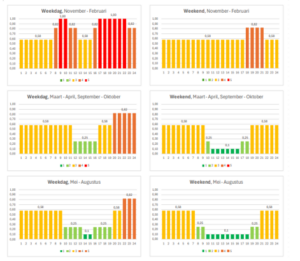
With the new draft decision, the ACM is now taking the next step. Transmission rates for businesses with a connection exceeding 3×80 amperes will become time-dependent: using the grid during off-peak hours will become cheaper, while large consumers will pay more during peak hours (see Figure 1). The effective date is January 1, 2028.
New Proposal for Households and Small Consumers
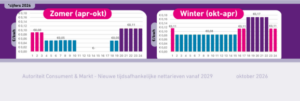
At the same time, the ACM is issuing a separate draft decision for households and businesses with a small connection of up to 3×80 amps. This goes beyond just a time-dependent aspect. Currently, households largely pay a fixed grid rate based on their connection. Under the new system, approximately one-third of the grid rate will remain fixed. About two-thirds will be calculated based on the actual number of kWh drawn from the grid. The rate per kWh drawn will then vary depending on the time of day: it will be higher during peak hours and lower during off-peak hours.
Time-of-use rates distinguish between off-peak and peak periods and vary between summer and winter (see Figure 2). According to the ACM, this is intended to shift electricity consumption to times when there is more capacity available on the power grid. As a result, grid operators expect a 10 percent reduction in peak load from households, creating capacity to connect approximately 700,000 additional homes without the need for grid upgrades. The implementation for small consumers will take effect on January 1, 2029.
Energy storage gives grid users options for action
ESNL views time-of-use grid rates as an important step toward an energy system in which flexible grid usage is actually rewarded. Energy storage plays a key role in this. With a battery installed behind the meter, electricity consumption can be shifted to different times. In this way, storage can help grid users better align their consumption with times when there is more capacity available on the power grid, while also saving money.
That said, it is important that households and businesses also have the opportunity and support to respond effectively to the new price incentives. For example, the business case must remain viable, which is not a given given the end of the net metering scheme and additional factors such as double energy taxation starting in 2027.
ESNL will respond to the ACM consultations
ESNL views the shift toward grid tariffs that encourage users to take available grid capacity into account as a positive development. At the same time, the specific design of these tariffs must ensure that flexibility can actually be realized and that investments in energy storage are encouraged where necessary.
The draft decisions are now open for public comment. ESNL will continue to evaluate the draft decisions in the coming period, focusing specifically on the implications and opportunities for energy storage and flexible grid use.
Latest News
 News
News
ACM Introduces Time-of-Use Grid Rates: An Important Step Toward Flexibility and Energy Storage
October 12, 2026 News
News
Looking Back: Energy Storage Day 2026 – Energy Storage as the Key to a Flexible Energy System
October 8, 2026 News
News