

Offshore Energy Storage: OESTER on Technology, System Value, and Integration in the North Sea
Energy Storage NL actively participates in knowledge and innovation projects. By being involved in research projects, we can substantively substantiate and quantify the added value of energy storage. We apply the results both within and outside our network, so that they directly contribute to our policy efforts. In this interview, we speak with Catherine Eeckels, Wind Energy Project Manager at TNO, about OESTER (Offshore Electricity Storage Technology Research), a three-year collaborative project in which sixteen European partners are working on the development and application of offshore energy storage. The project is investigating various technologies for short-, medium-, and long-term storage and is identifying the economic, environmental, and social conditions. Through this, OESTER aims to contribute to scalable solutions that make better use of offshore wind energy, reduce grid congestion, and develop the next generation of wind farms into integrated energy hubs.
OESTER is exploring the possibilities of offshore energy storage. What role do you see for offshore energy storage in the future energy system?
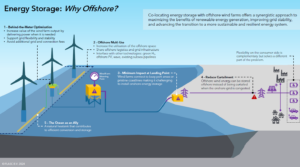
The Netherlands aims to generate 75% of its electricity from offshore wind by 2032, with an installed capacity of 21 GW. That is nearly five times the current installed capacity. As renewable energy scales up, the need for flexibility is increasing significantly. By around 2035, TenneT expects 16 GW of battery capacity, compared to the current installed capacity of 1.5 GW. Offshore energy storage can play a key role in meeting this need for flexibility. It can store excess wind energy and transmit it to land when little wind or solar energy is being produced or when energy demand is high. By combining storage with offshore wind, the system behind the meter can be optimized and space at sea can be used efficiently. This keeps scarce land space available for other purposes. Furthermore, this optimization makes it possible to utilize the planned offshore transmission capacity as effectively as possible. Alongside onshore energy storage, offshore energy storage is therefore one of the ways to add extra flexibility to the energy system.
The OESTER project is investigating various energy storage technologies, ranging from batteries in wind turbines to hydrogen and underground storage. Why was this combination of technologies chosen?
These storage technologies were selected because of their varying storage durations. Lithium-ion batteries can respond very quickly to developments in the energy markets and have a storage duration ranging from a few minutes to a few hours. Compressed air storage technologies, such as hydro-pneumatic offshore energy storage (HPES), FLASC technology, and Underwater Pumped Hydro Storage (UPHS), can store energy for longer periods: from a few hours to a full day, or four to sixteen hours. The Flexolyser, a flexible alkaline electrolyzer, converts electricity into hydrogen and can thus bridge periods ranging from several days to weeks.
The market for offshore energy storage is still in its early stages of development. Currently, there are only a few developers active in this field.
What is the current status of the project, and what key insights or milestones can you share so far?
We have now established initial sizing parameters and operational strategies for the various storage technologies that will be directly connected to a future wind farm. Our projections are based on the year 2035 and a 30-year lifespan for the wind farm. This timeline was chosen because the MOOI mission supports innovations and technologies that can be implemented within a ten-year period. We have also developed the initial technical concepts for the various storage technologies and their integration with the wind farm. A feasibility study identifies the challenges associated with installing each technology at an offshore wind farm. We are currently working on the business case and defining the scenarios for its analysis. In addition, we are assessing the environmental impact of the various technologies and the associated mitigation measures. For each technology, we are conducting a life-cycle analysis to provide developers with insight into the impact and potential areas for improvement. The consortium is also reviewing the relevant laws and regulations and investigating what additional steps are needed to make offshore energy storage possible.
OESTER considers not only the technology, but also economic, environmental, and social aspects. What challenges still need to be addressed before offshore energy storage can be implemented on a large scale?
With the continued expansion of offshore wind, the potential for offshore energy storage is significant. However, before large-scale implementation is possible, significant challenges must still be addressed.
These technologies are at various stages of development and need to mature further. In addition, costs are still relatively high at this time. Installation and maintenance at sea are more expensive than on land due to weather dependence, the use of specialized installation vessels, limited accessibility, and integration with offshore wind farms. Key areas of focus for cost reduction include standardization, reducing system complexity, extending service life, improving reliability, and further integration with wind farms. The most effective measures vary by technology. As the business cases are further developed, greater insight will emerge into the key cost drivers and opportunities for cost reduction.
Environmental impact and permitting also play an important role. It is important to assess the effects of storage technologies throughout their entire life cycle, from installation to decommissioning. In addition, new storage concepts must be properly integrated into existing regulations and aligned with other activities and interests in the North Sea, such as nature conservation, shipping, and fishing.
From an economic perspective, high investment costs, financing risks, and uncertainty about future revenues pose significant challenges. Future market developments and the impact of new policy instruments—such as the two-way Contracts for Difference (CfDs) to be introduced in the Netherlands starting in 2027—play a key role in this regard. At the same time, offshore energy storage can contribute to more efficient use of offshore infrastructure, reduce pressure on landfall sites, and potentially lower societal costs associated with grid expansions. Within OESTER, we are therefore investigating the technical, economic, environmental, and societal conditions under which offshore energy storage can make a cost-effective and scalable contribution to the future energy system.
What impact do you hope OESTER will ultimately have on the development of offshore energy storage and the Dutch energy storage sector?
My hope is that OESTER will clarify the potential value of offshore energy storage for the future energy system. Offshore storage can help absorb peaks in wind energy production, reduce congestion on the power grid, and make more efficient use of the available infrastructure. In addition, we want to gain insight into the total system value of offshore energy storage. In doing so, we look not only at the storage technology itself but at the entire chain, including grid infrastructure, energy supply, and societal costs and benefits. Another key objective is to understand under what conditions offshore energy storage can present an attractive business case for developers and what policy measures are needed to enable this development. At the same time, OESTER contributes to the further development of various storage technologies so that they can help create a robust, flexible, and energy-independent European energy system in the future.
Would you like to learn more about the knowledge and innovation projects? Register for Energy Storage Day on October 7 during the Energy Trade Show!
Image: TNO
Latest News
 Member News
QurmitXL Wins Two Innovation Awards in September
October 14, 2026 News
News
ACM Introduces Time-of-Use Grid Rates: An Important Step Toward Flexibility and Energy Storage
October 12, 2026 News
News