
National Action Agenda on Battery Systems Sets the Right Course; Implementation Is Now Crucial
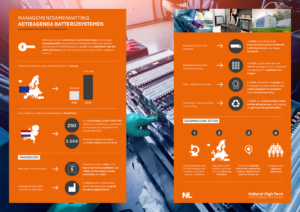
On Wednesday, September 23, during Battery Day NL, the revamped National Battery Systems Action Agenda launched. The agenda aims to scale up, industrialize, and implement Dutch knowledge and innovations more quickly, thereby contributing to a strong, innovative, and resilient battery ecosystem. This is relevant to the energy storage sector because the agenda sets the direction for the development and application of battery systems that contribute to a future-proof energy system. Energy Storage NL welcomes this direction but emphasizes that a concrete implementation plan is needed to actually realize these ambitions.
From Action Plans to Implementation
The agenda includes seven action lines that span the entire process from research and innovation to production and market application:
- Accelerate market access and adoption
- Build a path from innovation to industrial production
- Develop a digital and secure system layer
- Develop a high-quality circular battery supply chain
- Strengthen shared infrastructure and funding
- Strengthen talent and operational capacity
- Anchor the Netherlands in European value chains
Energy Storage NL endorses the direction of the action agenda and recognizes the key bottlenecks that are hindering the further development of the Dutch battery ecosystem. The action lines provide a solid foundation for innovation and industrial development, but they must also lead to broader adoption of energy storage to enhance grid flexibility and ensure more efficient use of the power grid. At present, the action lines are still too general to effectively motivate stakeholders to take action. A concrete implementation agenda is therefore necessary, with clear priorities, responsibilities, funding, and a realistic timeline.
Energy Storage NL is already putting various lines of action into practice. For example, the trade association is working to improve market and pricing frameworks so that the societal value and the contribution of energy storage to the energy system are better reflected in the business case for storage projects. In addition, Energy Storage NL is working with partners on a collective system for industrial batteries. This enables manufacturers to meet their obligations under the European Battery Regulation while simultaneously working toward a high-quality circular battery supply chain.
Strategic Decisions for the Battery Ecosystem
The agenda is structured around five focus areas: heavy-duty and dual-use applications, stationary battery systems, next-generation components and materials, manufacturing equipment, and the circular value chain. For each of these themes, preconditions, ambitious “moonshots,” and concrete action plans have been developed to accelerate innovation, upscaling, and industrialization. In addition, the agenda identifies conditions that are important for all themes, including data and safety, the digital battery passport, battery cell production, a sufficient supply of technical personnel, and international cooperation.
Energy Storage NL particularly supports the focus on stationary battery systems, innovative battery technologies, and the circular value chain. To achieve this, an effective system for the collection and processing of industrial batteries must first be established; only then can requirements be set for the quality of reuse, repurposing, and recycling. It is also important that new battery technologies be developed not only for mobility but also specifically for stationary applications. The overarching themes are equally relevant, but certain aspects still require concrete implementation and a clear alignment with European developments.
From Recognition to Concrete Action
Through the National Action Agenda for Battery Systems, the government explicitly recognizes batteries as a strategic technology for the energy, industrial, and mobility transitions. The agenda sets an important course for innovation, production capacity, and the development of a strong Dutch battery ecosystem. At the same time, Energy Storage NL emphasizes that the existing Dutch energy storage market also requires attention. Many of the bottlenecks have now been identified, but concrete solutions, responsibilities, and timelines are still lacking for issues such as grid tariffs, permitting, grid congestion, and appropriate contract types.
The Comprehensive Energy Storage Policy Agenda, which is expected to be published in mid-October, should further address these challenges facing the current storage market. This is urgent because large-scale energy storage is already needed to store renewable energy, maintain the balance of the electricity system, and reduce grid congestion. The National Action Agenda for Battery Systems thus takes an important step toward innovation and industrial development, but concrete measures for the existing storage market remain necessary. Energy Storage NL therefore remains committed to improving the framework conditions for energy storage and advocates for close collaboration between the government, the industry, and research institutions in the implementation of both agendas.