
KfW Study: Battery Storage Reduces System Costs and Boosts Renewable Energy
The German bank KfW has published a study on the role of battery storage in the energy transition. The study A study by the bank—which is 80% owned by the German government—shows that battery storage smooths out daily price fluctuations in the electricity market, increases the market value of renewable energy, and lowers the average cost of the electricity system. As a result, solar and wind farms receive more revenue for the electricity they generate, while consumers pay less during the evening peak.
Energy Storage NL endorses these conclusions and expects that batteries can have the same positive effect in the Netherlands. However, this requires the right market conditions. The ACM and government authorities play an important role in creating those conditions. The market environment in Germany is currently considerably more favorable. Therefore, additional steps are needed in the Netherlands to fully realize the potential of energy storage.
The Benefits of Battery Storage
Battery storage helps mitigate fluctuations in the electricity market caused by wind and solar energy. Since 1991, the prices of lithium-ion storage have fallen by 99%. Looking ahead to 2035, the study expects a further decline of 19%. This price trend and the favorable German investment climate for BESS have led to 19 GW/29 GWh of installed capacity by June 2026. Germany thus currently has the largest BESS capacity in Europe. Unlike in the Netherlands, this consists largely of residential batteries. The German pipeline already includes 400 GW of battery projects. Sodium-ion storage is also on the rise there.
BESS offers several benefits for the electricity system, including high energy density and fast response times. According to the study, storage also reduces the system costs of the energy transition. Batteries limit the curtailment of renewable generation and thus reduce the additional generation and backup capacity needed to achieve the same climate goals. For households with a heat pump and an electric car, the study found that energy bills could be 57% lower with a combination of solar panels and a 10-kW home battery. CE Delft calculated that for the Netherlands, similar conclusion. Companies can use behind-the-meter storage as a backup or for trading on the energy markets. Large-scale front-of-the-meter storage has various applications. In balancing markets, storage helps ensure a stable electricity system. In Germany, the share of storage in these markets is growing relative to other technologies. In addition, storage can improve the business case for solar energy. Solar farms largely generate power at the same time. This can lead to low or negative prices and, consequently, to the waste of renewable electricity.
Impact on wholesale prices and energy bills
Large-scale batteries smooth out peaks and troughs in electricity prices. They typically charge when supply is high and prices are low, such as around noon. When demand and prices are higher, such as in the evening, they feed electricity back into the grid. This flattens the daily price curve and helps maintain the market value of renewable electricity.
According to the study, these market forces do not automatically lead to grid-supporting behavior. Large-scale storage often relieves pressure on the power grid as a side effect, but in specific situations, it can actually exacerbate local congestion. For example, a battery might charge due to low prices on the national market, while a local wind surplus cannot reach the battery because of congestion. In such cases, dispatchable power plants must absorb the additional demand locally. Conversely, discharging in an area with a local surplus when national prices are high can place an additional strain on the local grid. In both situations, more wind energy may need to be curtailed.
As long as the wholesale price does not reflect regional shortages, grid tariffs can, according to the study, incentivize batteries to support the grid. Dynamic grid tariffs that take into account the location and timing of congestion can enable batteries to charge and discharge in a targeted manner where this actually relieves the grid. This supports location- and time-dependent tariffs, although practical implementation is complex.
Batteries are expected to slow the decline in the wholesale price around noon, as they purchase additional electricity at that time. In the evening, they limit the price increase by feeding electricity back into the grid. For Germany, the study shows that for every additional MW of large-scale battery capacity, prices between 10:00 a.m. and 3:00 p.m. are on average €0.14/MWh higher and, between 6:00 p.m. and 9:00 p.m., €0.38/MWh lower per GW. The difference between midday and evening prices is thus reduced by €0.52/MWh. This confirms that large-scale batteries flatten the daily price curve (see the figure). The effect diminishes as more storage capacity is added. This indicates diminishing returns and, consequently, an optimal share of storage in the electricity system.
For residential batteries and commercial behind-the-meter storage, this effect on the price profile is barely noticeable. These systems are primarily controlled based on their own consumption, are often fully charged before noon, and generally do not offer their electricity on the day-ahead market.
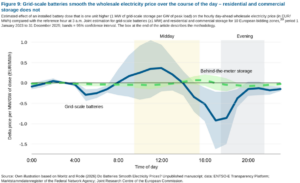
The daily estimates show that one additional unit of large-scale battery capacity is associated with a decrease in daily price differentials of €1.50 to €1.70/MWh. Applied to the German expansion between 2023 and 2025, this amounts to a decrease in the daily price spread of approximately €18 to €20/MWh. That is approximately 17 to 19% of the average German daily price spread of €108/MWh. At the same time, the spread of hourly prices throughout the day decreased by approximately 16%.
The study concludes that battery storage is a key driver of the energy transition. Storage smooths out daily price fluctuations, supports the market value of renewable energy, and lowers the average cost of the electricity system. At the same time, the current market design does not sufficiently highlight where storage helps or burdens the grid. Therefore, the study advocates for incentives that better reflect local and time-specific grid constraints. In this way, the charging and discharging of batteries can take place not only in a market-driven manner but also in a way that demonstrably supports the grid.
‘This study confirms that battery storage not only offers opportunities for project developers, but also makes the energy transition as a whole cheaper and more efficient. But that won’t happen on its own. The Netherlands must therefore create market conditions that will allow this societal value to be truly realized,’ said Arendo Schreurs, director of Energy Storage NL.
Energy Storage NL: Improve Market Conditions
Energy Storage NL endorses the study’s main conclusion: battery storage smooths out daily price fluctuations, increases the market value of solar and wind energy, and can reduce the costs of the electricity system. In the Netherlands, too, batteries can fulfill this role by charging when there is a large supply of renewable electricity and feeding power back into the grid when demand and prices are higher.
The introduction of time-of-use electricity rates in the Netherlands, scheduled to begin in 2029, is an important step in this regard. If designed properly, this will provide a strong incentive for batteries to charge and discharge at times when this is beneficial not only for the market but also for the power grid. This also reduces the risk that batteries will exacerbate congestion.
In theory, location-based grid tariffs could also contribute to more efficient grid usage. They provide a stronger incentive for storage facilities to locate and operate in areas where the system value is greatest. Energy Storage NL views this as an interesting line of thinking, but its implementation requires careful consideration and more time. The rates must be predictable and feasible and must not create uncertainty that jeopardizes the financial viability of storage.
For energy storage to fulfill this societal role in the Netherlands, the benefits to the electricity system and grid efficiency must be more clearly recognized. This can be achieved, for example, by making time-dependent transmission rights (TDTR) more widely available or by implementing a tariff structure that better recognizes that storage is not an end user, but rather temporarily draws electricity and later feeds it back into the system. A better recognition of this function is needed to improve the Dutch investment climate for battery storage and to realize the positive effects identified in the German study here as well. The conclusion is clear: without storage, the energy transition will ultimately become more expensive for everyone.