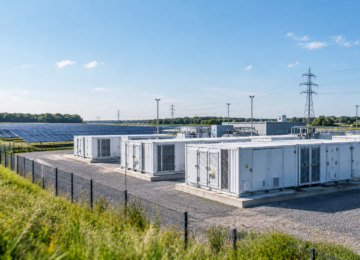

DNV: Large-scale batteries can alleviate grid congestion
Large-scale batteries are technically capable of alleviating grid congestion and thereby connecting customers on the waiting list more quickly. That is the conclusion reached by DNV in its study Integration of Large-Scale Batteries in Relation to the Congestion Issue, commissioned by the Ministry of Economic Affairs and Climate Policy (EZK). The report is last Monday attached to the House of Representatives with the Energy Storage Policy Agenda. Energy Storage NL participated in the study’s advisory group and is particularly pleased that the potential of storage to alleviate grid congestion has now been independently verified.
A reassessment of previous conclusions
Previous research commissioned by the government concluded that large-scale batteries could not alleviate grid congestion and, in many cases, would actually exacerbate it. Due to the rapid development of battery technology and new contract types, Energy Storage NL and Netbeheer Nederland saw reason to request a new study in 2025. The regulations have also changed. Amendments to the Electricity System Code (formerly the Grid Code) allow grid operators to require customers connected at capacities greater than 1 MW to participate in congestion management. This enables grid operators to exclude batteries from peak demand, which forms an important basis for the new insights.
DNV re-examined those conclusions between January and June 2026. The study focuses on batteries larger than 1 MW on the medium-, high-, and extra-high-voltage grids. The emphasis is on demand-side congestion, as its societal costs are much higher than those of feed-in congestion. In addition to EZK, TenneT, Stedin, IPO, VNG, and ACM, Energy Storage NL also provided input through discussions and the sounding board group.
Batteries do not worsen traffic congestion
According to DNV, virtually all large-scale batteries connected in the coming years will operate in a manner that is at least congestion-neutral. They will be connected under contract types such as the time-duration-based transmission right (TDTR) and the capacity management contract (CSC). This allows the grid operator to prevent a battery from exacerbating congestion. Furthermore, a firm connection does not provide a viable business case for batteries due to the relatively high grid tariffs.
According to DNV, additional policies to enforce congestion neutrality are therefore unnecessary. Instead, policy should focus on congestionenlightening Use of batteries, where technically and economically feasible.
Technically, it's possible; economically, it's now becoming clear how
DNV sees no technological barriers preventing the upscaling of batteries as a means of alleviating congestion. Grid operators indicate that 60 to 80 percent of congestion points have sufficient capacity to deploy a battery for congestion mitigation. Where this is the case, a battery can reduce peak load at the congestion point by 15 to 30 percent. Batteries can also make a contribution in areas with long periods of congestion, for example, in combination with other flexibility options.
According to DNV, it is still too early to say whether batteries will be economically viable on a large scale. That depends on the compensation rates under the CSC and on the efficiency assessment applied by grid operators. There is significant interest from the market: approximately 80 percent of applications for congestion reliever status involve large-scale batteries. DNV notes that the costs of grid reinforcement are not the appropriate benchmark. After all, the purpose of a congestion reliever is not to avoid grid reinforcement, but to connect customers on the waiting list more quickly.
Fourteen recommendations
DNV makes fourteen policy recommendations addressed to the national government, the ACM, network operators, and municipalities (the competent authorities). Here is a selection:
- Grid operators provide insight into where congestion-relief measures are needed and what the optimal scale is for each area, so that market participants and municipalities can respond accordingly.
- Grid operators are issuing flex tenders in congested areas where batteries could help, but few bids have been submitted so far.
- The efficiency assessment takes into account that the grid is being utilized more effectively and that the grid operator receives additional revenue when customers on the waiting list are connected.
- A capacity fee in the CSC is established for the battery's economic lifespan, not just for the congestion period.
- The national government is developing a nationwide assessment framework for large-scale battery storage facilities and is assisting municipalities with the permitting process.
According to DNV, the tools are available, but it is primarily the grid operators—and, to a lesser extent, municipalities—that are setting the pace. The market is ready, with dozens of gigawatts in the pipeline. DNV calls the accelerated scaling up of flextenders a crucial next step.
Response Energy Storage NL
Energy Storage NL endorses DNV’s conclusions. The fact that the congestion-relieving potential of storage has now been independently verified on behalf of the national government is an important step. It confirms what the sector is already seeing in practice: batteries do not exacerbate congestion and can help reduce wait times.
“This study independently demonstrates that energy storage can make a real contribution to solving grid congestion,” says Arendo Schreurs, director of Energy Storage NL. “We are pleased that the government is recognizing that potential in the Energy Storage Policy Agenda, both now and for the long term. Now it’s time for implementation: identifying where batteries are needed, scaling up flex tenders, and establishing contract terms that make it feasible to use batteries to alleviate grid congestion.”