

Election talk energy: Aldermen talk to each other
On March 2, 2026, an election discussion on energy, co-organized by Energy Storage NL and other industry associations from the energy sector, took place at Eindhoven City Hall. At the table were aldermen Rik Thijs (GroenLinks-PvdA, Eindhoven), Stijn Nijssen (VVD, Oostzaan), Maaike Zwart (STIP, Delft), Tobias van Elferen (D66, Nijmegen) and Marco Verloop (SGP, Veenendaal).
The focus was on one of the most defining themes of the municipal elections: energy transition. What became especially clear during the discussion: energy transition is no longer an abstract climate issue. It is daily administrative practice.
From heat grids to high-voltage pylons. From transformer box space to local energy storage and batteries. From grid congestion to the question of who pays the bill. Municipalities are in the middle of implementation, and therefore in the middle of the conversation with residents.
From invisible to visible energy system
Councilman Tobias van Elferen (D66, Nijmegen) put it aptly: “we are moving from an invisible energy system to a visible energy system.” Where energy used to be mainly something that came out of the wall socket, it now requires physical space, political choices and managerial courage.
This also means a new role for administrators. The energy system directly touches the living environment of residents. That requires a different way of working, different communication and new collaborations.
Heat as a local task
In several municipalities, it became clear how concrete that task now is.
In Delft, a geothermal heat source is being used, with the first delivery taking place since last week. In Nijmegen, the development of a heat network is in full swing, with housing corporations playing a crucial role - and needing support.
Also in Veenendaal, the DEVO heat grid, including storage and the broader ‘energy web,’ was cited as an example of how local ownership and systems thinking come together in practice.
The comparison that was made was striking: municipalities do not normally have to answer publicly for the construction of a sewer system or drinking water supply, but around heat they do. This underlines how energy is now not only a technical task, but also a political and social issue.
Energy storage: not fear, but necessity
From Energy Storage NL, it was interesting to hear how energy storage is viewed. In Eindhoven it was emphasized that energy storage is an important part of the future energy system, and that batteries are not seen as “the next big problem” for the city. It was also pointed out that in practice the spatial incorporation of batteries is often less radical than for other energy projects, such as large-scale generation or grid reinforcement. This underscores that storage is increasingly seen as part of the solution, rather than a new spatial or societal burden.
Storage helps to make the energy system more stable, to absorb peaks and to make better use of locally generated energy. In an energy system that is becoming increasingly visible, flexibility plays a key role.
Party color matters less than thought
Perhaps the most reassuring conclusion of the evening: party color matters less in practice than is often thought. Whether it was GroenLinks-PvdA, VVD, STIP, D66 or SGP - all aldermen outlined similar challenges. Everyone is in the same boat.
What does make a difference is the language municipalities use. How do you explain why a transformer house is needed? How do you include residents and businesses in the need for a heat grid? How do you position storage as a system solution?
Municipalities want to move forward
What became clear: these municipalities want to make this energy transition happen. They are taking responsibility. But they need clear regulations from the government, clear communication from the grid operators and room for cooperation to do so.
For Energy Storage NL, this evening confirms that energy storage is an integral part of the local energy transition. Not as a goal in itself, but as a precondition for a reliable, affordable and future-proof energy system.
After the municipal elections, we therefore want to actively support municipalities on energy-related issues. By sharing knowledge and continuing the conversation, we like to contribute to feasible and future-proof solutions at the local level.
Want to watch the talk back? You can do that via this link.
Latest News
 Member News
QurmitXL Wins Two Innovation Awards in September
October 14, 2026 News
News
ACM Introduces Time-of-Use Grid Rates: An Important Step Toward Flexibility and Energy Storage
October 12, 2026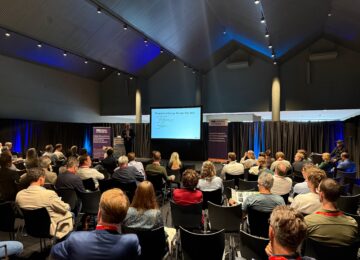 News
News